
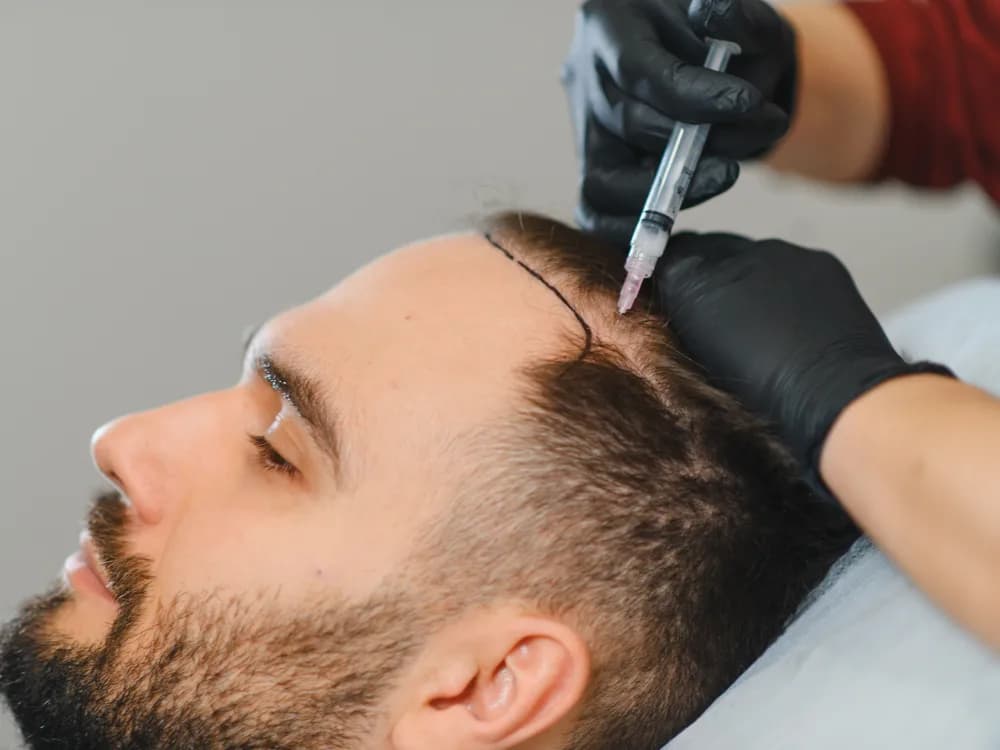
How Many Grafts Do You Need for a Hair Transplant? Norwood Stages
The number of grafts needed for a hair transplant depends on Norwood stage, donor area and hair density. Read the typical ranges in this article.
Medically reviewed by Op. Dr. Elvin Əliyev.
There is no fixed number of grafts needed for a hair transplant — it varies depending on the Norwood stage of baldness, the size of the balding area, the capacity of the donor area, and the natural density of the hair. The real requirement can only be determined by an in-person examination of the hairline, crown area and donor region. This article covers typical ranges by stage and the main factors that affect graft count.
The Norwood scale: what the stages of baldness mean
The Norwood scale is a widely used system for describing how far male-pattern hair loss has progressed. It covers stages from mild recession at the temples to complete baldness of the crown area. This classification gives the doctor a starting point for surgical planning, but because each patient's hairline shape and area size is individual, the final decision always rests on an in-person examination.
At early stages (mild recession at the temples), rather than rushing into surgery, it is recommended to watch whether hair loss has stabilized, since ongoing shedding can lead to new areas opening up in the future. At medium and advanced stages, correctly assessing the donor area plays a more decisive role.
Typical graft range by stage
The table below shows the approximate ranges commonly referenced in the field. These are not exact figures — only a general guide for initial planning:
| Norwood stage | Main area of loss | Typical graft range |
|---|---|---|
| II | Temple hairline | 500-800 |
| III / III Vertex | Temples + crown onset | 800-1300 |
| IV | Front line + crown | 1300-1800 |
| V | Extensive crown area | 1800-2500 |
| VI-VII | Extensive, merged baldness | 2500-3500 |
These figures are only a guide — the exact number is determined solely during an in-person consultation.
Donor area capacity: how many grafts can be taken
The donor area, usually the back and sides of the scalp, has a limited number of follicles. The total reserve generally considered safe over a lifetime is usually estimated in the 6000-8000 graft range, but this varies from person to person depending on hair density and head size. At an extensive Norwood VI-VII stage, fully covering the whole lost area in one go is not always possible with the donor reserve, and in that case the doctor offers a balance between density and outcome.
The laxity of the donor area, meaning how freely the scalp skin moves, also affects how many follicles can be extracted. Harvesting too densely from one spot can cause thinning in the donor area itself, so the doctor assesses the donor area not as a whole but in terms of even distribution.
Other factors that affect graft count
Beyond the Norwood stage, the following factors directly affect the number of grafts needed and can shift the ranges from the table in either direction:
- Natural hair density — thinner hair may need more grafts to cover the same area.
- Hair shaft thickness — thicker strands create more visual volume.
- Contrast between hair color and scalp color — less contrast can give a denser look with fewer grafts.
- Wavy or curly hair structure — curly hair can cover a larger area with the same count.
How many grafts can be transplanted in one session?
A single session usually transplants somewhere between 2000 and 4000 grafts, with the exact figure depending on the doctor's assessment and the length of the session. For larger areas requiring more, the process is usually split into two separate sessions to preserve result quality and follicle survival. In such cases, a gap of several months is usually kept between sessions so the scalp fully heals and the donor area is ready for the second session. More detail on the overall procedure is on the hair transplant page.
Does graft count differ between FUE and DHI?
A frequently asked question: the method itself (FUE or DHI) does not change the number of grafts needed — in both methods the requirement is set by the same Norwood stage and area size. The difference shows up more in transplant speed, instrument technique and the hairline design details. The practical differences between the two methods are covered in the FUE vs DHI comparison.
When to see a doctor
Before planning graft count, a specialist examination is essential in the following cases:
- Hair loss is still ongoing and has not stabilized — in this case an early transplant may require an additional session later.
- There is inflammation, psoriasis or another dermatological condition on the scalp.
- Hair loss is diffuse in character and does not match a clear Norwood pattern.
- There is a family history of early, rapid baldness.
- Hair loss is being observed in a woman — this requires a different assessment and is explained in a separate article on hair loss and transplantation in women.
Frequently asked questions
Can a dense result be achieved with fewer grafts?
Hair shaft thickness, color contrast and correct placement affect visual density, but a minimum count requirement exists for larger areas. An exact assessment is made at an individual examination.
What happens if the donor area runs out?
Because the donor reserve is limited, using too much of it at once can reduce options for future needs. That is why doctors often take long-term planning into account.
Does graft count alone determine the quality of the result?
No. Alongside graft count, placement angle, density distribution, hairline design and the surgeon's experience also meaningfully affect the final look. A high count on its own does not guarantee a dense result.
How is graft count determined at a consultation?
The doctor personally assesses the scalp, the donor area and the size of the balding area, and a digital scan is sometimes used to determine the area precisely. You can book a consultation for this assessment through Dr Plasty.
This article is for information only and does not replace a medical consultation.
Related procedures
Related articles

Next step: a free consultation
Fill in the form — our team will contact you as soon as possible with the right specialist, a personal plan and an exact price.
Free
Completely free, no obligation
The right doctor
The right specialist for you
Transparent price
Transparent price — no hidden costs
Confidentiality
Full confidentiality