
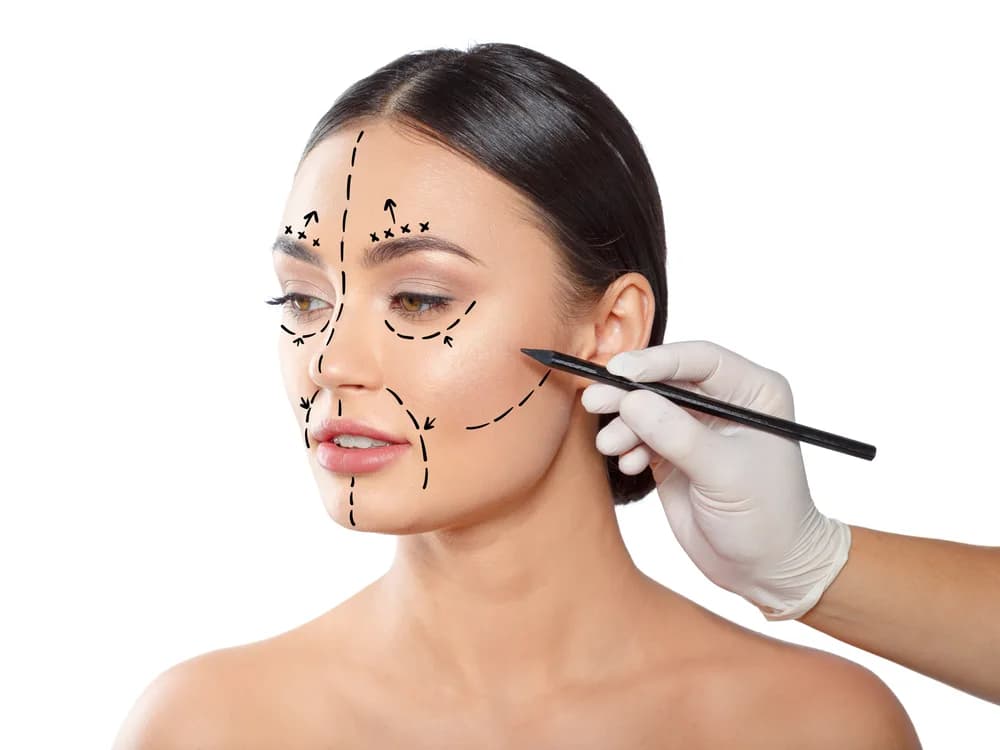
Facelift Types: Mini, SMAS and Deep Plane Explained
What is the difference between mini, SMAS and deep plane facelift? Which tissue layer each lifts, how long results last and who each suits.
Medically reviewed by Op. Dr. Elvin Əliyev.
Facelift surgery has several different techniques, and the main difference between them is how deep a layer of tissue is lifted. A mini facelift tightens only the skin, an SMAS facelift also works on the muscle-connective tissue layer beneath the skin, while a deep plane facelift moves an even deeper layer of the face. Choosing between the three depends on the degree of sagging, how long you want the result to last, and how much downtime you are ready for.
What is a mini facelift?
A mini facelift is the least invasive technique. Incisions are usually shorter and placed around the ear, and the surgeon mainly tightens the skin, with little or no work on the deeper layers. This technique is designed to correct mild sagging along the jawline and the lower cheeks, but if there is significant sagging in the neck or midface, it is not enough on its own.
The advantage of this technique is a relatively short operation and a change that does not look too dramatic - the result reads as a rested look rather than a "pulled" one. The downside is that the deeper tissue layer is not touched, so sagging continues in that layer, and the result can fade faster than with other techniques.
A mini facelift is usually considered suitable for:
- Mild sagging along the jawline
- No significant sagging yet in the neck or midface
- A first-time facelift
- Wanting a shorter recovery and smaller incisions
The result usually lasts 3-5 years, because the deeper tissue layer is not touched and the aging process continues there.
What is an SMAS facelift?
SMAS stands for the muscle-connective tissue layer beneath the facial skin. During an SMAS facelift, the surgeon tightens or repositions not just the skin but this layer as well. The result looks more natural because the skin is not stretched artificially - the underlying structure is repositioned too.
This technique is recommended for jowls, cheek descent and pronounced nasolabial folds (the lines between the nose and mouth). Recovery is somewhat longer than a mini facelift: visible swelling and bruising usually last 2-3 weeks. In return, the result also lasts longer - usually 7-10 years.
An SMAS facelift is one of the most commonly chosen techniques today, because it offers a relatively balanced middle ground between result and invasiveness. Many surgeons consider it a first choice for patients with moderate sagging, especially when the jawline-to-neck transition has not fully lost definition yet.
How is a deep plane facelift different?
A deep plane facelift goes beneath the SMAS layer and repositions, as a single unit, the deep layer surrounding the cheek fat pad, moving it upward and backward. Where other techniques lift the skin and the deeper layer separately, in a deep plane facelift these layers move as one unit.
This is used for significant midface descent, deep nasolabial folds and sagging under the chin, to produce a more natural and longer-lasting result. Because the technique is technically more complex, the surgeon's experience matters especially. Recovery is similar to an SMAS facelift - swelling and bruising usually last 2-3 weeks - but the result is expected to last longer, sometimes 10-15 years.
Comparing the three techniques
| Technique | What it lifts | How long the result usually lasts |
|---|---|---|
| Mini facelift | Skin only | 3-5 years |
| SMAS facelift | Skin and the SMAS layer | 7-10 years |
| Deep plane facelift | Skin, SMAS and the deeper layer beneath it | 10-15 years |
It is not the name of the technique but your facial anatomy and degree of sagging that determine which one suits you.
Which technique suits you?
This choice requires an individual assessment. The surgeon makes a recommendation based on your face, skin elasticity, bone structure and the condition of the neck area. If there is also sagging or platysma bands (muscle cords) in the neck, a facelift alone may not be enough - in that case it can be planned together with a neck lift. For more on which signs of neck sagging need a separate procedure: article on neck lift.
When preparing for facelift surgery, knowing in advance how recovery unfolds makes the decision easier - more on that here: facelift recovery article. You can book a consultation with a plastic surgeon through Dr Plasty to discuss directly which technique suits your situation.
When to see a doctor
Regardless of which facelift technique is chosen, see a doctor immediately in the following cases:
- Sudden, rapidly increasing swelling on one side of the face (can be a sign of a hematoma)
- Redness, warmth, pus, or a bad smell around the incisions
- Difficulty breathing or unusual changes in heartbeat
- Numbness that does not go away or that gradually worsens
- Asymmetry in facial muscle movement, for example a smile that does not work on one side
These signs are not part of normal recovery and should be evaluated promptly.
Frequently asked questions
Is a mini facelift considered less risky than an SMAS facelift?
In general, a less invasive technique means a shorter operation and recovery, but every procedure carries its own risks. The level of risk depends less on the chosen technique and more on the surgeon's experience and your overall health.
Is a deep plane facelift more painful?
Pain perception varies from person to person. Because a deep plane facelift involves a larger area of tissue, tension and pressure may feel stronger in the first days, but this is a temporary state managed with painkillers.
Is it possible to move from one technique to another later?
Yes, for example years after a mini facelift, an SMAS or deep plane facelift can be considered. But because every operation leaves a trace in the tissue, planning the next one has to take the earlier procedure into account.
Does a facelift also correct sagging in the neck?
A standard facelift is mainly aimed at the face and jawline and may not fully address sagging in the lower neck and platysma bands. In these cases, a separate neck lift procedure, or one planned together with the facelift, is recommended.
This article is for information only and does not replace a medical consultation.
Related procedures


Next step: a free consultation
Fill in the form — our team will contact you as soon as possible with the right specialist, a personal plan and an exact price.
Free
Completely free, no obligation
The right doctor
The right specialist for you
Transparent price
Transparent price — no hidden costs
Confidentiality
Full confidentiality